

With AI literacy increasingly knocking at the classroom door, via local initiative or statewide mandate, it’s important that everyone designing or supporting that work be clear about what they’re inviting in.
When my co-teacher Scott Kern and I create curriculum in this area, we think of AI literacy as providing students a specific kind of readiness: our goal is to get them ready to shape our AI future, not just prepared to live inside someone else’s vision.
To explain what we mean by that, I’ll first share an upcoming lesson that embodies this goal. Afterwards, I’ll explore why I think that goal is so important.
Here’s the lesson:
Part 1: What are the CEO visions?
First, we’ll have students engage with excerpts from the CEO posts below, using the questions listed after each post.
(For space here, I’m only including a few sentences of each CEO statement; students will read longer excerpts during the actual lesson.)
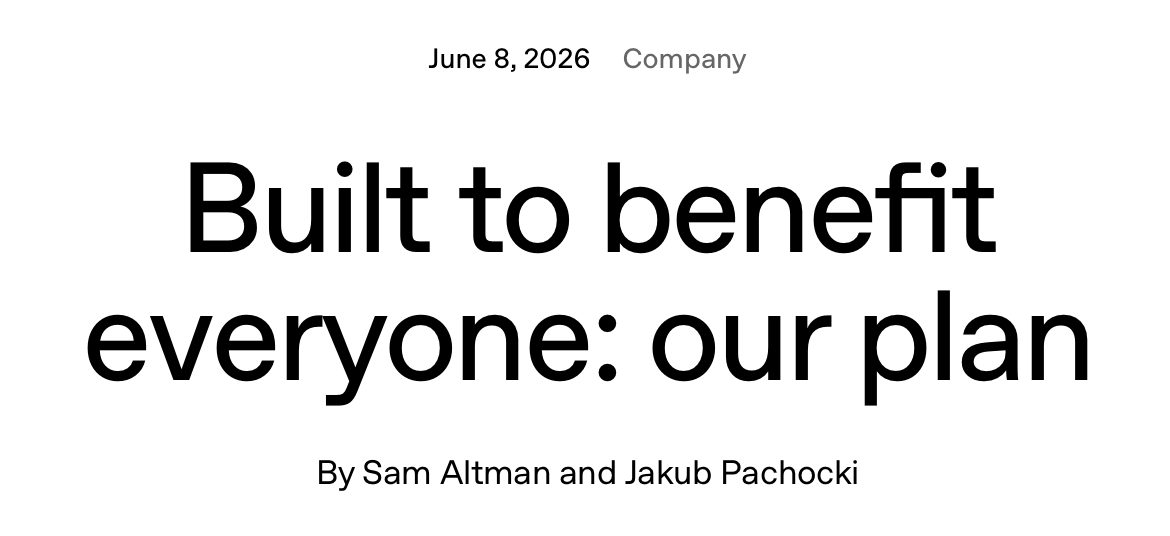
Imagine electricity reaching a rural American town in the 1920s…Electricity did not transform every household overnight, and many of its benefits reached people unevenly. But as access spread, ordinary life changed…
The first promise of electricity was practical, but its deeper impact came from the new possibilities it opened as more people could use it…
This is happening again with AI.
What does Altman’s analogy between electricity and AI show us about AI? What does it make harder for us to see about AI?
Why might Altman have chosen to use that historical analogy, as opposed to another one? Why wouldn’t he want to compare AI to, say, nuclear power?
What do you agree with in his AI vision? What is missing from this vision of AI?
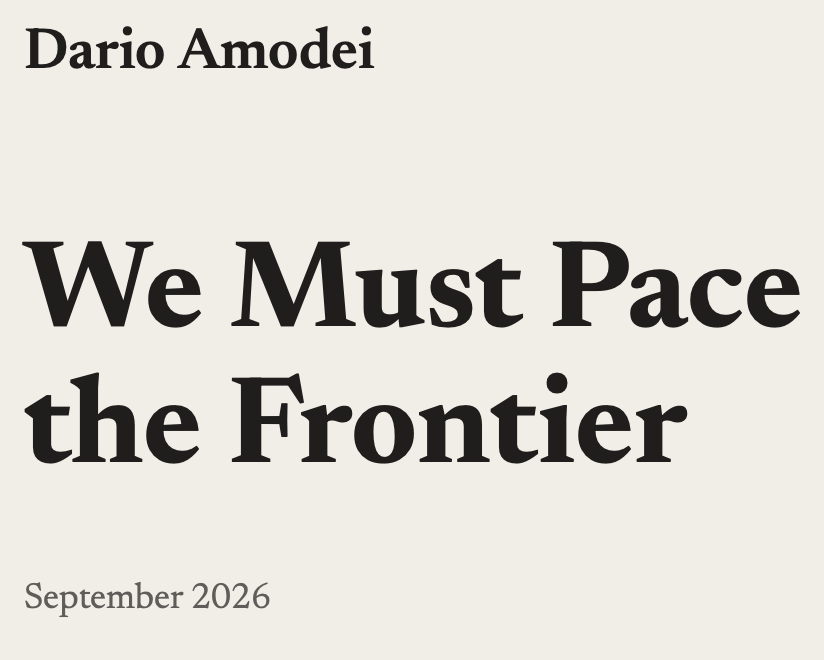
I have worked on AI for the last twelve years because I believe it could dramatically raise the quality of human life. I’ve written often about these incredible benefits: I believe that AI could cure most major diseases in the next 5–10 years, greatly accelerate economic growth rates, create a world of abundance and empowerment, and usher in a renaissance of democracy and freedom…
But like many technologies before it, AI brings risks, and because it is such a powerful technology, these risks are serious.
Why does Amodei open his piece by describing AI’s potential benefits in those ways? Why does he move from specifics (curing most diseases in 5–10 years) to abstractions (abundance, empowerment, freedom)? What would happen if he flipped the order of that sentence?
Amodei was the first AI leader this fall to call for “pacing,” or slowing down, the development of AI. Why might he have wanted to be the first to do that, and why does he talk about AI risk so soon, in the second paragraph of his piece?
What do you agree with in his AI vision? What is missing from this vision of AI?

We are fortunate to live at an incredible moment in history…
The defining questions of our age are who will have access to superintelligence and what will we direct it towards. Will it be centralized and restricted to a few institutions, or will it be a tool that empowers everyone?
We propose a philosophy based on individual empowerment as the source of prosperity, invention as the primary purpose of superintelligence, and balance of power as the foundation of safety.
How does Zuckerberg’s vision for AI differ from Altman’s and Amodei’s?
How might that difference relate to the other apps/platforms Zuckerberg runs like Facebook, Instagram, and WhatsApp? (Altman’s and Amodei’s companies only focus on AI.)
What do you agree with in his AI vision? What is missing from this vision of AI?
And finally:
If you had to pick one of those three CEO visions you agree with most, which one would you pick and why? Which do you disagree with most?
Part 2: What is your vision?
We’ll then have students sit in the CEO chair.
We’ll ask them to craft the opening of their future AI vision, as if they are making the same kind of public proclamation (without the attendant IPO implications).
They’ll need to pick a title and write the opening two paragraphs. We’ll offer this structure:
Create a dramatic title (seven words or fewer)
Design your opening. Here are some options, but you can also choose your own way to open your vision.
Create an image or metaphor
Refer to another time in history or another group of people
Make a logical argument
Compare and contrast
Tell a personal story
Try to convince people who disagree with you
Create the second part of your vision. Here are some options, or feel free to do it your own way.
Explain what you think the future of AI should look like. How should people be using AI, or not using it?
Give examples of what your positive future will look like on a daily basis. Tell some short stories from that future.
Show how your vision for the future of AI is different from other visions out there (including the CEO visions we just read!).
Part 3: What are our visions?
In that lesson or the next one, if we run out of time, students will then do a kind of gallery walk in which they read their peers’ AI visions.
If we wanted to stretch this sequence out to its fullest extent, we’d use the extra time to have students discuss their respective visions as a class and then try to synthesize them into a shared vision. One example of that kind of shared vision came at the end of our course last spring, as I wrote about at the time. Here’s an excerpt:
First, AI is a tool, not an intelligence. It’s a talking library built from everything humans have ever known.
Second, AI should sharpen human thinking, not replace it. Learning is lost when convenience becomes more important than growth.
I know I’m biased here, but I’d put our students’ vision up against a CEO’s any day.
The two faces of readiness
The kind of AI literacy lesson described above shows, I hope, how AI readiness can support student agency. The goal is to help students realize that they have as much right to imagine the AI future as the CEOs of the labs do. One way to make that clear to young people is to show them that the adults are just imagining too.
When they take apart the CEO visions to look at the beliefs and assumptions embedded within, and then find words for their own beliefs and assumptions, students hopefully see they have as much to say about AI as anyone else.
This approach is akin to the work done by young people over the summer to create the Students First Act, a set of AI guidelines crafted by students from all 50 states (the full text of the act is at the end of that article). The point is to help young people find their voice on this issue and then use it.
There is another face to readiness, though. AI literacy can cultivate agency, but it can also encourage surrender.
If we teach AI only as a tool to learn, we’re also teaching students that this technology is a fait accompli and they need to fall in line. If we teach AI as a topic but treat that topic as settled fact, we’re teaching young people that they need to adjust to the world adults have created. They become guests in someone else’s house.
The problem I’ve found is that the line between those two, agency and surrender, can be blurry. I’ve told upperclassmen this year, “When you’re applying for internships and jobs in college and after, you need to be ready to explain how you’d use AI in that career field, when you’d decide not to, and the unique gifts you bring that AI can’t emulate.” I’m going for agency there, but it could well be misheard as acceptance.
I think one key here involves our own mindset as educators. If we think of ourselves as downstream from the decisions being made about AI, by companies and countries, our students will come to see themselves as downstream too. If we feel like we are perpetually on defense, trying to protect our profession from a many-pronged tech attack, our students will develop a siege mentality too.
If we think of this moment as a threshold, though, it could change how our classrooms feel. For ancient Romans, doorways were often as sacred as the space onto which they opened. Janus was their god of doors, and therefore also a god of transitions and beginnings and endings. As such, he had two faces.
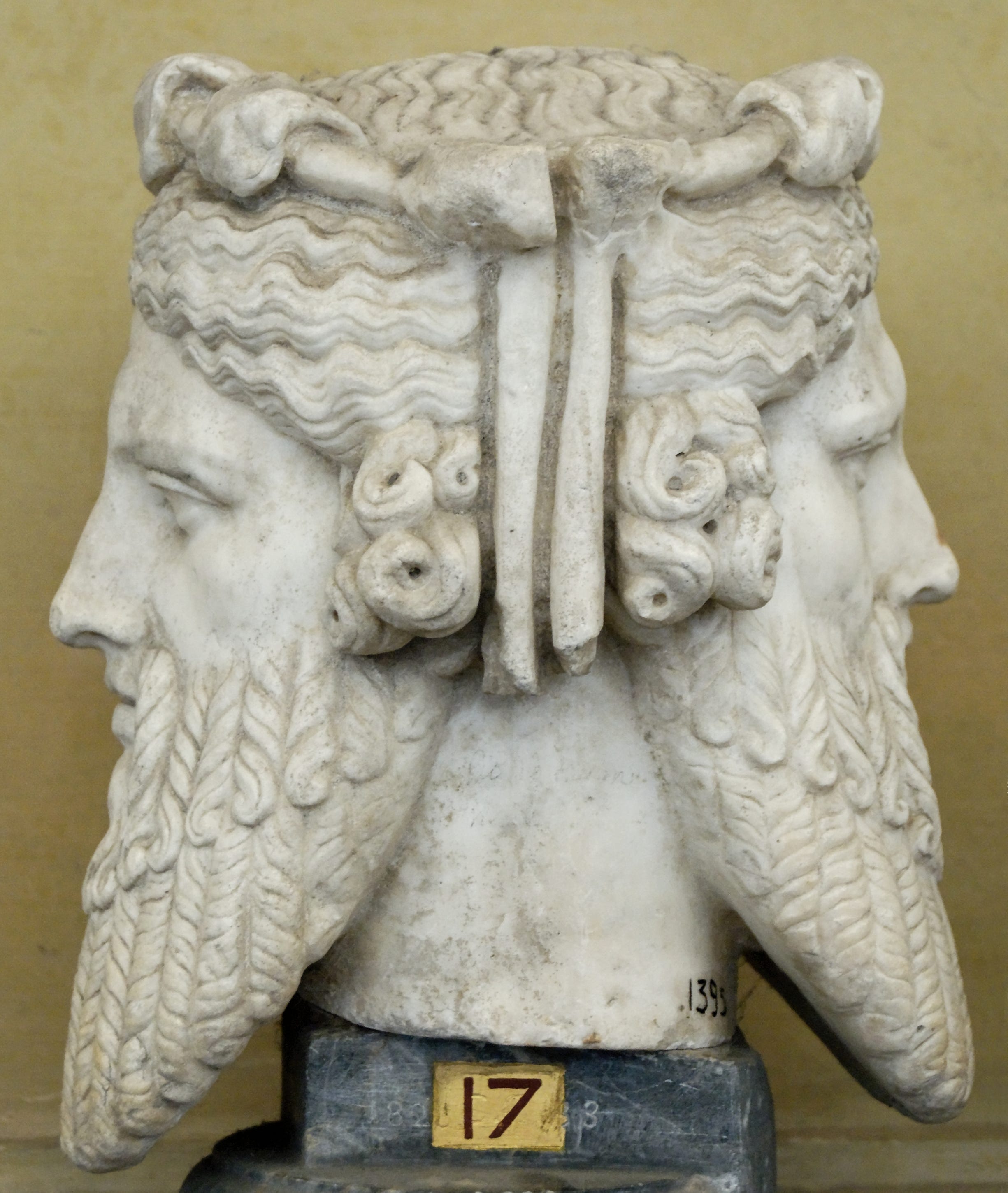

We are at the end of one era in education and the start of a new one. We’re at a threshold. But no one has been on the other side of this door before. All of us, CEOs and students alike, are walking through at the same time.
In a sense this has always been the case for schools; students graduating high school in 2019 were graduating into a different world than students in 2009 or than me in 1999. But first the pandemic years and now the AI years have made that truism about time much more stark.
Starkness can also bring clarity. Educators are trying to figure out what comes next, as are politicians and economists and artists and the AI labs themselves. It’s clear to us as adults that no one is clear on a long-term plan yet. Students deserve to be let in on that ironic clarity.
To invite them in is also to acknowledge another way this is the end of an era. When I was first becoming a teacher, it felt like there were clear, competing visions about what education should look like (progressive Coalition-style schools and no-excuses charters were the two I was trying to reconcile). Even if they were in flux, such visions had intellectual lineages to draw from and school models to point to.
AI readiness as preparation — as surrender — hearkens back to that era. Students wind up thinking they need to find their place in a finished world. That mindset leaves them and us facing the past.
If we can shift our perspective, though, an unsettling freedom beckons. Education in the AI era has no proven models yet, only early hypotheses.
It can be hard to face that. Well-trodden paths promise both predictability and absolution: no matter what happens, we can’t really be blamed for doing what so many others have done.
But we are well off the beaten path at this point. Ever since the morning in March 2020 when I drew a flattened curve on the board to help students picture why the world was suddenly closing down, teaching has often felt like an attempt not to explain but to process. There has never been quite enough time to prep in education, but now on a certain level it’s as if there is none.
If we face that uncertainty alongside our students, we can cross this threshold together.
If we don’t, we risk closing the door in students’ faces and telling them to wait, then forcing them to knock before we open it again, letting them into a world we built while they were outside.
Great post, Mike. I really like the comparison of the CEO visions. Where is Google's? A friend shared this site with me which I also thought was pretty interesting.
https://itsnotyouits.ai/#chapter-1
So, so many thoughts on those statements. I am not sure to what extent sharing is possible, but I would personally find it incredibly interesting to see what your students produce and what questions they ask.