

I opened the session last Friday by saying, “You might be wondering what an hour engaging with AI has to do with community service.” It turned out the 9th and 10th graders were indeed wondering that.
On our school’s annual Community Service Day, we send as many students as we can out into the world to plant gardens, play bingo with older residents, clean up parks, and generally be of service. But we couldn’t connect with quite enough external organizations for every advisory to be of service out in the world this year, so some stayed at school. Several teachers came up with service-oriented, hour-long sessions for them to rotate among. I was asked to do one about AI.
I’ll share here what I did for that hour, because by the third time through I was realizing there might be some useful ideas for other educators in the session. I also thought my uncertainty by the end might be helpful too, since I imagine that’s what many of us feel as we feel our way through the AI moment.
Minutes 0-5
This slide (made with Ideogram) was up when students walked into the room:
I opened with the line from the start of this post. When students nodded, I added:
AI is here. It’s going to affect the world you graduate into in a few years. You’re doing a service to our community by knowing what it can do and also what the implications are of what it can do. My generation is mostly creating this opportunity/problem, so we need your generation to start thinking about how you want to handle it all. That’s what we’ll be doing for the next hour: talking about how you think we should handle AI.
But first, you’re going to make some songs.
I then explained our opening activity.
Minutes 5-15
I switched to this slide:
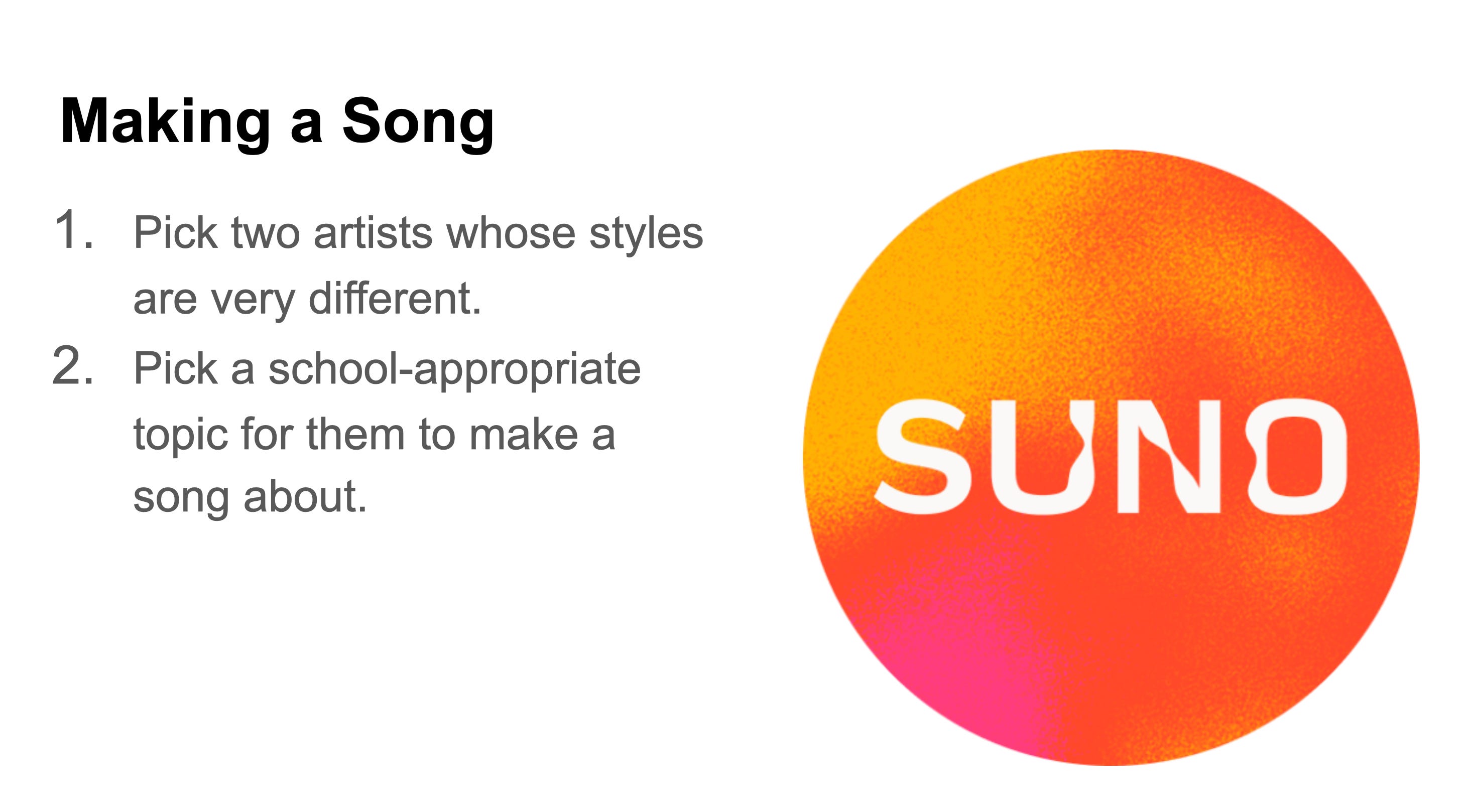
Students worked in pairs or small groups to come up with the most original or off-the-wall artist collaborations they could think of, singing about whatever topic came to mind. Two of my favorites over the course of the three sessions:
The Weeknd and Beethoven: “Five Minutes,” a song about only having five minutes to find your homework before leaving for school.
Kendrick Lamar and Olivia Dean: “Half-Empty Tank,” a song about musing on recent heartbreak while driving an expensive foreign car.
To make all this happen in real time, I had students tell me the artists and song topic. I then gave that information to a Claude project I had prepped to churn out song titles, lyrics, and style notes based on the artists and topics we put in. I then cut and pasted those topics into the relevant boxes on Suno and let that AI make the music.
As the first songs came on, students were taken aback. It seemed many hadn’t realized how far AI music generators had come. They were nodding along to the beats and saying “oooh” at lyrics like “I gave you my heart, but you wanted the bank / Now I’m in the coupe with a half-empty tank.”
But after the initial shock wore off, they were less and less impressed. They started pointing out that the voices didn’t sound like the artists we had put in. I explained the copyright issues. They complained that all the songs were starting to sound the same. I explained the model was probably tuning itself to our requests during this session.
When it was clear they had heard enough, we started a short discussion about the whole experience.
Minutes 15-25
To spark the conversation and give them a little more context, we started by watching parts of this video about Suno’s business model and the mixed artist reactions to it. (We watched 0:00-1:35 and 2:45-3:00 for time but the whole video is useful.)
I then asked students: “What do you think about AI music? Should it be allowed? Will there be a time, before you graduate high school, when people will develop preferences for AI music versus human music? Will some people say things like ‘I turn the AI music preference button to off when I stream’ in the future?”
Students talked in groups. They were mostly of the opinion that AI music is a negative development. They said things like:
“Human artists need to be the ones creating music. We have human imagination.”
“AI hasn’t had any experiences. How is it supposed to sing like it’s feeling something?”
“Real music takes time.”
To end the conversation, I said, “So you think you’ll always be able to tell if a song was AI created?” Most of them nodded, but they were a little less sure about that. I then said, “Let’s see if you can tell when a movie is AI created.”
Minutes 25-40
I explained briefly what Seedance 2 is, and then we watched those clips of Tom Cruise and Brad Pitt fighting that had caused such a stir in February.
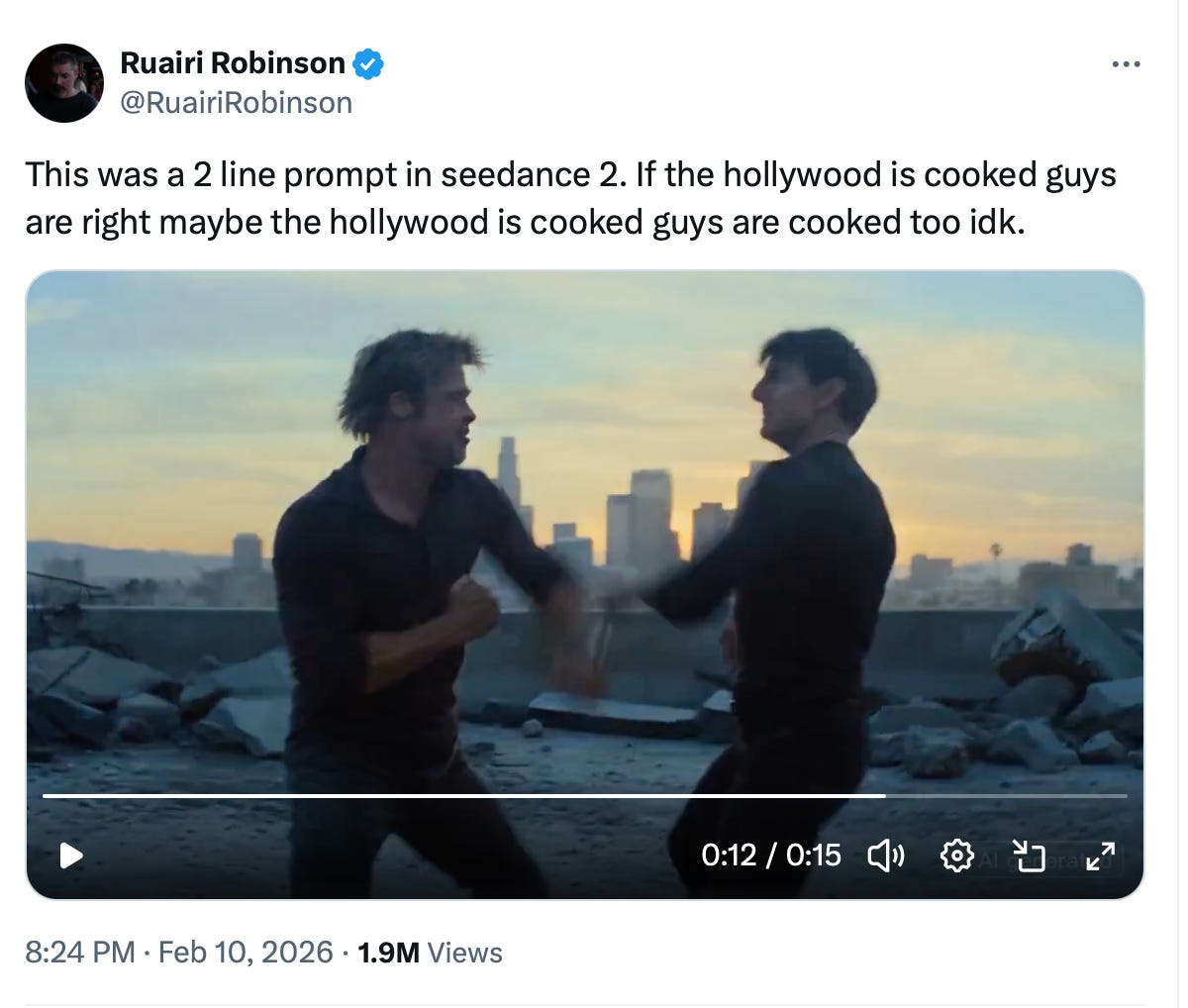
We discussed if students could tell that was AI. Some said it was obvious, others were not so sure. But most students believed they would be able to tell if a movie was AI.
I said, “Ok, you all seem pretty confident about this. Here’s a short film, just two minutes long. It was made by someone named Sebastian Lopez. But did he use AI or really film this? At the end I want you to tell me if this is AI or real.”
We all watched. At the end, students talked in groups. We then took a vote. In each period it was basically fifty-fifty between AI and real. (My guess is this was partly the point Lopez was trying to make in the clever choices he made as a director.)
Want to watch and guess yourself before I share the answer, to see what the students experienced in class?
If so, don’t look anything up first. And don’t scroll any further down here!
I then revealed that the film was a genuine human production, with no AI involved as far as I knew, except maybe that part with the six-fingered hand.
I asked: “If you all, young people who watch a lot of movies and shows, are split 50-50 on whether something is AI now, and it’s only 2026, where is this going? Will there eventually be AI movies you don’t know are AI? Like with music, will people start to develop preferences for AI movies or human movies, like each is its own genre?”
We had a spirited, though too short, conversation. It was time to pull back the curtain on TikTok.
Minutes 40-50
We’re going to play a game using TikTok (or another social media like Instagram if you prefer). Here’s what you need to keep in mind: these platforms want to keep you watching. That’s their goal because it’s part of their business model. They make money from your attention. So their goal is to get you to keep watching once you’re on.
And to do that, they use AI. There is an AI choosing the videos you watch on TikTok or the pictures you see on Instagram.
So…what is the video you think TikTok’s AI is going to show you when you open it up in a moment? Don’t open it yet! Think about it: what video do you think TikTok’s AI thinks is going to hook you right away? What topic or person or situation is the AI going to choose for you?
Students shared their guesses in groups. They then opened their apps to see what the AI chose.
Their reactions were a range; some students seemed to just get lost in the TikTok stream immediately, while others maintained enough critical distance to see the choice the AI made. Those students woke their friends up from the social media trance that had set in, saying:
“I was just talking about buying this game!”
“I was literally just thinking about what tattoo I should get.”
“I’m always hungry at this time on Fridays and they started with an Applebees ad.”
I’ve heard these conversations devolve into conspiracy theories about TikTok secretly turning on the mic on people’s phones, so I jumped in quickly:
This is not a conspiracy. It’s something you agreed to. We all do. It’s what’s in those terms of service we never read and just agree to when we download an app. I do the same thing with LinkedIn, the boring social media I’m on. Now I’m going to show you what the AI inside social media does with the information you agree to give it.
We then watched three minutes of The Social Dilemma, from 16:30 to 19:30, pausing in the middle to linger on this shot:
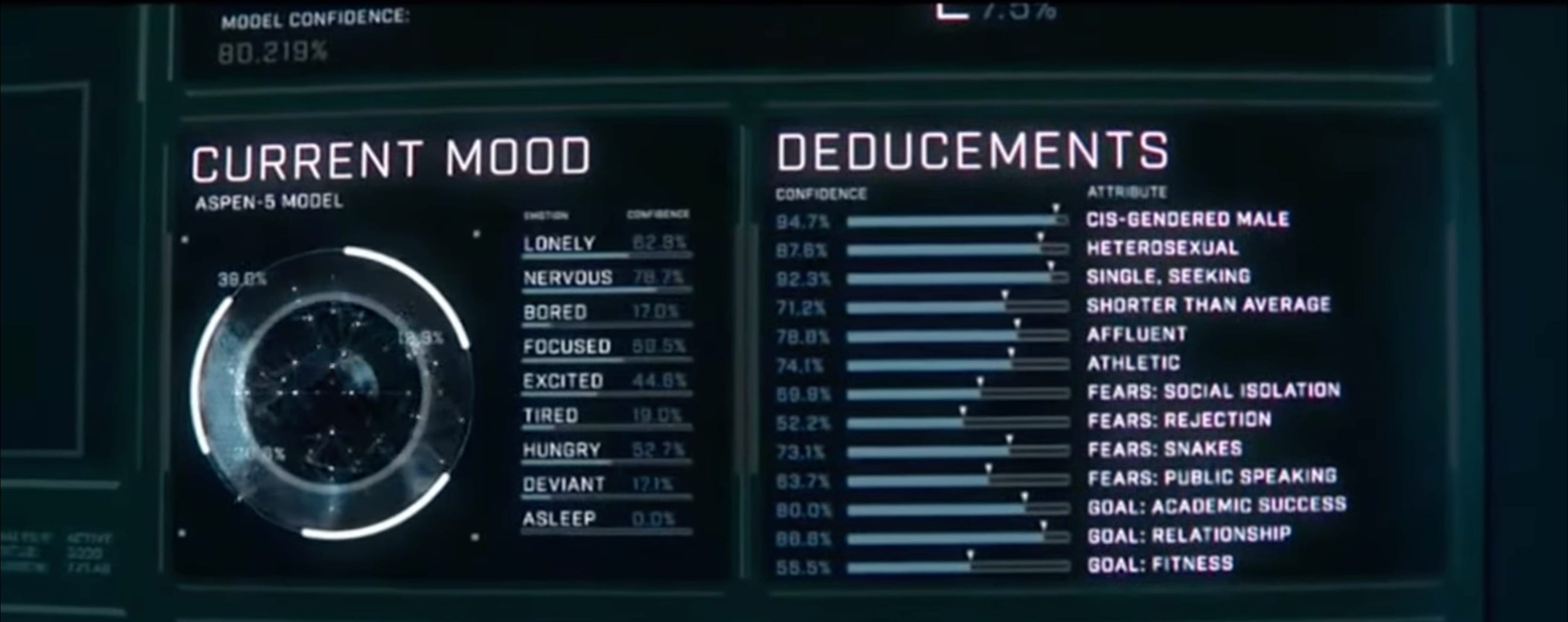
I read off the lists on both sides of the screen and said,
This isn’t a real screen inside TikTok; it’s a dramatization by the documentary makers. But TikTok and Instagram do know these kinds of things about you. And you don’t have to tell them any of this for them to know it. They’re deducing it, using AI, based on which videos you watch, how long you watch them for, which ones you like, etc.
It was at this point in the second session of the day that one freshman’s jaw dropped. Having taught English for many years, I mostly associated this expression with an extremely dramatic plot twist in a story. I hadn’t seen it in an AI context yet.
The other thing I hadn’t seen quite as clearly was the fear he was suddenly feeling. He was sitting near the window, and the light coming into the room illuminated his widening eyes. And as any teacher will tell you, when one student is visibly feeling or thinking something, many others are too, just less visibly.
I suddenly wondered if this session, taught to students I don’t usually teach, had been both too effective and not effective enough. In classrooms, pacing is often the secret to a good lesson. But the unforgiving pace of the AI era can make pacing in AI lessons hard. I had five minutes to land a plane I’d flown into turbulence of my own making.
Minutes 50-55
Remember what I said at the start? It's literally a service to our community for your generation to be thinking about all this. You're the ones inheriting this world, AI parts included, and we need you thinking critically about this tech, not just using it. But the thinking you're doing is also power. Next time you open TikTok, you'll be more aware of what its AI is trying to do to you. Now you can watch TikTok, not just watch TikTok. You can break the spell. Same with AI music or movies. Once you know how it works, you can decide what we should do about it.
You see what I mean?
I’m not sure they all did. With class rapidly ending, this was not my best closing or checking-for-understanding moment.
In my experience, timing is a central tension in all AI work with students these days. If we give students enough time to really see what AI can do, there often isn’t enough time to reflect and debrief on the implications. If we make time for the discussion, it’s often too thin because it’s not based on an understanding of AI’s current capabilities and future trendlines.
To put it another way, my AI work with students often see-saws between emotions: excitement and confusion, intrigue and avoidance, curiosity and fear. One class period never seems to be enough to find balance. And unlike teaching English, when I always knew how the story would end, this time I’m in media res with the students. It’s hard to plan for plot twists.
But despite my regrets about this particular lesson plan — too many activities in one hour, too little time to discuss — I still think it was important to try. To me the real mistake would not be a poorly paced lesson that mistakenly leaves students with more fear than agency. It would be letting students continue to use TikTok like no one’s watching, or letting them go through high school like AI isn’t waiting outside.
I didn’t subject the underclassmen to TS Eliot, but this part of “Four Quartets” was on my mind as I wrote this a few days later, feeling like a veteran educator who’s somehow a first-year teacher again when it comes to teaching AI:
Trying to use words, and every attempt
Is a wholly new start, and a different kind of failure
...
but there is no competition—
There is only the fight to recover what has been lost
And found and lost again and again: and now, under conditions
That seem unpropitious. But perhaps neither gain nor loss.
For us, there is only the trying.
Minutes 55-60
As they walked out the door, I played some of the Suno songs from the start we hadn’t gotten to. One student asked to hear his K-pop/techno brainrot ballad “Ohio Glitchgyatt” again, which I understood even less the second time. I heard another student joke to a friend, “We should’ve asked people to stop using water while we were making all those songs.” That felt like something the students out gardening would appreciate. Then the next group walked in.
As always, such great reflections, Mike! How to keep following through with these conversations and allowing for space for continued discourse is something I keep coming back to as well. And having the ability to evolve our thinking/opinions as we learn more.
Great lesson, Mike! Thanks for sharing! I hope you'll write about impacts you see going forward amongst these students. Will you survey them on how this lesson affected their use of TikTok, for example?