

Last week, at the start of this summertime series engaging with key questions for AI literacy advocates, I asked, “What does AI literacy mean?” I argued AI literacy could be understood as a new form of the literacy English teachers have long taught.
This week I want to take up a question that, to me, follows from that idea:
If AI is a text, what does reading it look like?
As I mentioned last week, one of my favorite books to teach was Another Country by James Baldwin. 12th graders and I wrestled with it in a course I taught for many years before launching the class I teach now, so I had many chances to be challenged by Baldwin.
One of my favorite passages in the text has one of the protagonists, Vivaldo, on a West Village rooftop at night with friends. He’s resting on his back, knees up, looking at the sky overhead. He sees it this way:
The sky looked, now, like a vast and friendly ocean, in which drowning was forbidden, and the stars seemed stationed there, like beacons. To what country did this ocean lead? for oceans always led to some great good place: hence, sailors, missionaries, saints, and Americans.
What a paragraph!
After reading the full scene out loud in class together, a student or I would first draw a stick-figure diagram on the board so students could see the scene Baldwin was laying out. We would then start annotating that picture, drawing arrows to each person and symbol and jotting down what they seemed to mean.
Then we got into the language.
Baldwin has the sky become a “vast and friendly ocean.” The stars become “beacons.” The ocean-sky leads to some “country.” (This is where at least one student each period would flip back to the cover of the novel in excitement, remembering the book is titled Another Country.) Baldwin inverts the world, with Vivaldo looking down at the ocean-sky beneath him, sticking (like Spiderman, some student would often point out) to the upside-down rooftop above.
That’s usually all we got through before it was time for students to write and reflect on Baldwin’s argument by themselves, then discuss as a whole class, and then write some final takeaways before the bell rang.
Looking at the passage now, though, I see some ideas we didn’t get to. Maybe that’s for the best — those other ideas were meant more for me than for a classroom full of young people of color. Or maybe that’s all the more reason for us to have seen them? What would Baldwin have wanted, I wonder.
Let’s see.
Vivaldo is white, in a novel in which characters’ race features prominently. I’m white. Vivaldo is looking at an ocean that is “vast and friendly” and leads to “some great good place.” Baldwin’s suggesting, in part, that this is the ocean that led to America. And here is a white American who sees friendliness and goodness — and greatness — reflected back at him when he thinks about the journey to this country. There were other journeys to this country on that ocean, though.
Is that why Baldwin ends the paragraph with “hence, sailors, missionaries, saints, and Americans”? What is he saying, then, about Americans? About us? About me? What do I see reflected when I look at his word-waves?
Here’s what AI sees.
I just put this prompt into Fable, Anthropic’s most advanced Claude model:
Interpret this passage from James Baldwin’s novel “Another Country.”
The sky looked, now, like a vast and friendly ocean, in which drowning was forbidden, and the stars seemed stationed there, like beacons. To what country did this ocean lead? For oceans always led to some great good place: hence, sailors, missionaries, saints, and Americans.
It “thought” for about two minutes. Then it came back with this:
This passage is Baldwin working in his signature double register: it begins as consolation and ends as a joke with teeth, and the interpretation lives in that turn.
Start with the inversion. The sky becomes an ocean — above becomes below, air becomes water…
Then, a little later:
Since oceans always lead to some great good place, whole categories of humanity are explained by the crossing: sailors, missionaries, saints... and then “Americans” lands as the punchline. A nation, Baldwin implies, constituted by a faith about destinations: Puritans, the city on a hill, the immigrant’s golden shore… But the wit is also an indictment, because the sentence conspicuously omits the one Atlantic crossing that founded Black America.
It concludes:
So the passage performs, in three sentences, the whole novel’s argument: it grants the beauty of the hope and then gently exposes it as the most American of illusions, the story people tell about the horizon. Baldwin never quite renounces the hope. He only insists we notice that the horizon, once reached, is never the great good place. It is only ever another country.
I have to admit, I’m impressed. I’ve spent most of my adult life, first in college as an English major and then in education as an English teacher, analyzing texts carefully. In two minutes, Fable hit every major note students and I ever did over many years of conversations about this passage. It also explored the implications above that I didn’t take our classroom into, for better or worse.
But Fable showed some of its cards as it was “thinking.” Here’s one moment while it gathered its “thoughts” before responding to my prompt:
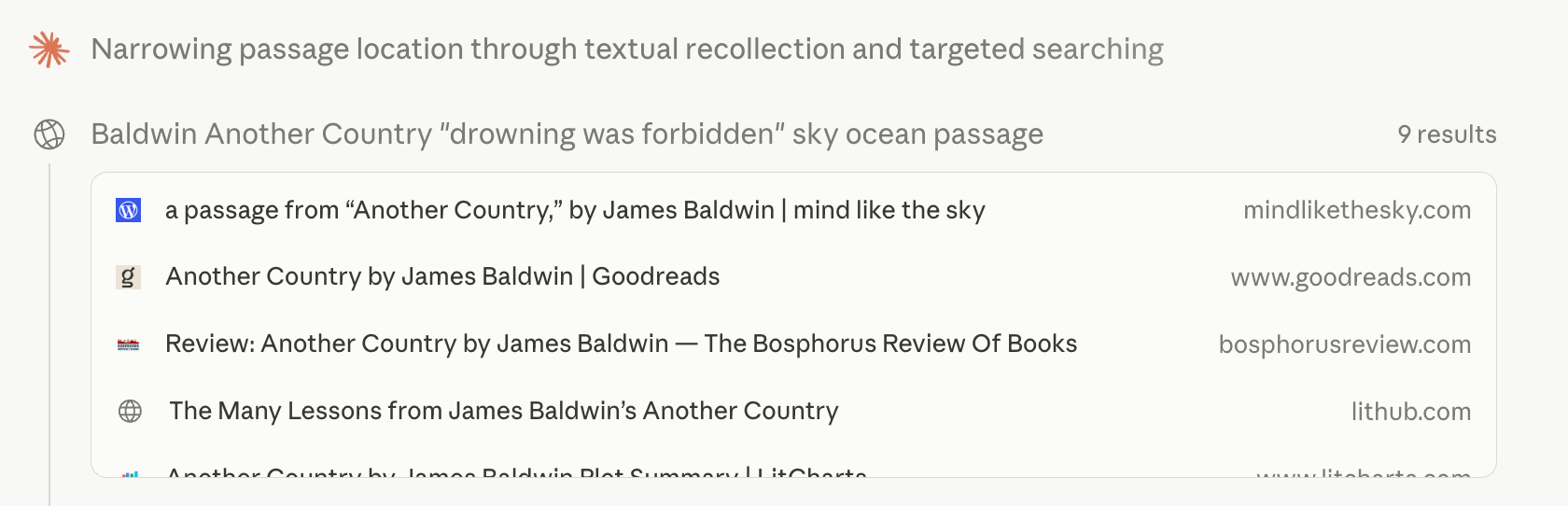
It was reading what other people had to say about all this. Or more accurately, it was scraping up some search data so it could better predict the next token as it answered my question. Notice it didn’t reference The Bosphorus Review of Books or Goodreads in its answer. All those ideas were presented as Fable’s, and implicitly as original. This is all you see when the response is done:

You can click on the line at the top, “Excavated literary layers…,” and see all the “thinking” again. But that’s not what the AI’s design is encouraging. Why not, a reader might ask. What’s the subtext?
Now let’s get into the language:
This passage is Baldwin working in his signature double register…
“Signature double register” is exactly how Baldwin’s voice shouldn’t be described. “Signature” as an adjective is a branding term — signature scent, signature dish — while I associate Baldwin’s work with an interrogation of signatures and signing, the noun and verb.
And the closing continues the classic Claude tone:
He only insists we notice that the horizon, once reached, is never the great good place. It is only ever another country.
In my experience, Claude has been designed to go for a polite clincher. Politeness is another kind of prose Baldwin rejects. His words — especially last words — ring, trying to wake us up, not to soothe us with a false finality. Baldwin likely would also have had some thoughts about the relationship between Claude’s designers’ experience of America, Claude’s training data, and that signature Claude politeness.
Ironically, I suspect that if Fable had simply read Another Country when it responded to me, instead of reading about it, it might have answered in a way that was more true to the novel’s spirit. But that’s part of the point: AI is agglomerating and synthesizing, not focusing.
Fundamentally, Fable’s prose exposes how little it has at stake. When I read that passage and come to those same ideas, I feel uncomfortable. It’s hard to keep looking at them if I’m really looking at them. Those are deep waters.
But that same analysis came very comfortably to Fable once it finished deciding how to combine training data, search results, model weights, probability, and inferred user preference, and began unspooling its tokens. Fable could do this all day.
Seeing that difference is what it means to read AI. So is opening the hood and looking at how Fable came to those ideas in the first place.
AI literacy means, in part, teaching students to read AI that way. To realize that the warning underneath every prompt window should actually say, “AI can make mistakes, but drowning has been forbidden.”
Really great example and illustration of how AI "answers" themselves are ripe for analysis/interpretation. It's a lot to add on for a student encountering a text for the first time and trying to make sense of it, but I'm thinking that maybe that's the assignment - i.e. to argue against the AI response (or some aspect of it) with evidence from the text. Food for thought, indeed.
This was such a pointed discussion of what AI can do, how we can and should investigate it.....this uncovering is potent. Thank you for this deep dive and for "showing" what AI is capable of in the depths...I think the drowning could teach us something too.