
The AI Two-Step
How I taught AI use on Tuesday and how students used it after

Reflecting on my recent instruction around AI and students’ use of AI, I realized there’s a two-step motion involved. (This may also be the product of listening to “Texas Hold ‘Em” by Beyoncé on repeat during recent drives to and from school with my daughters — radio edit of course.)
Here’s what that looked like during a recent mini-lesson I did on AI use, and during students’ use of AI following that mini-lesson. All of these examples come from the purpose development and career-connected learning program I run for juniors and seniors.
My Mini Lesson
To start class this Tuesday, I opened with an example of how students should use AI during their career-related projects that day, and also how they should ideally use it in other academic settings as well.
I started by using our AI Assistant, a custom bot I made for use this week, to design a three-week project related to my professional road not taken: astronomy. (Here’s the bot if you’d like to try it yourself. It’s called “Loop 5 AI Assistant” because our program is broken up into three-week loops.)
Based on my input, the bot focused my project on the study of planets in other solar systems. I showed students this on a slide:

As it did for students, the bot broke the project down for me into three weeks, which I showed on the next slide:
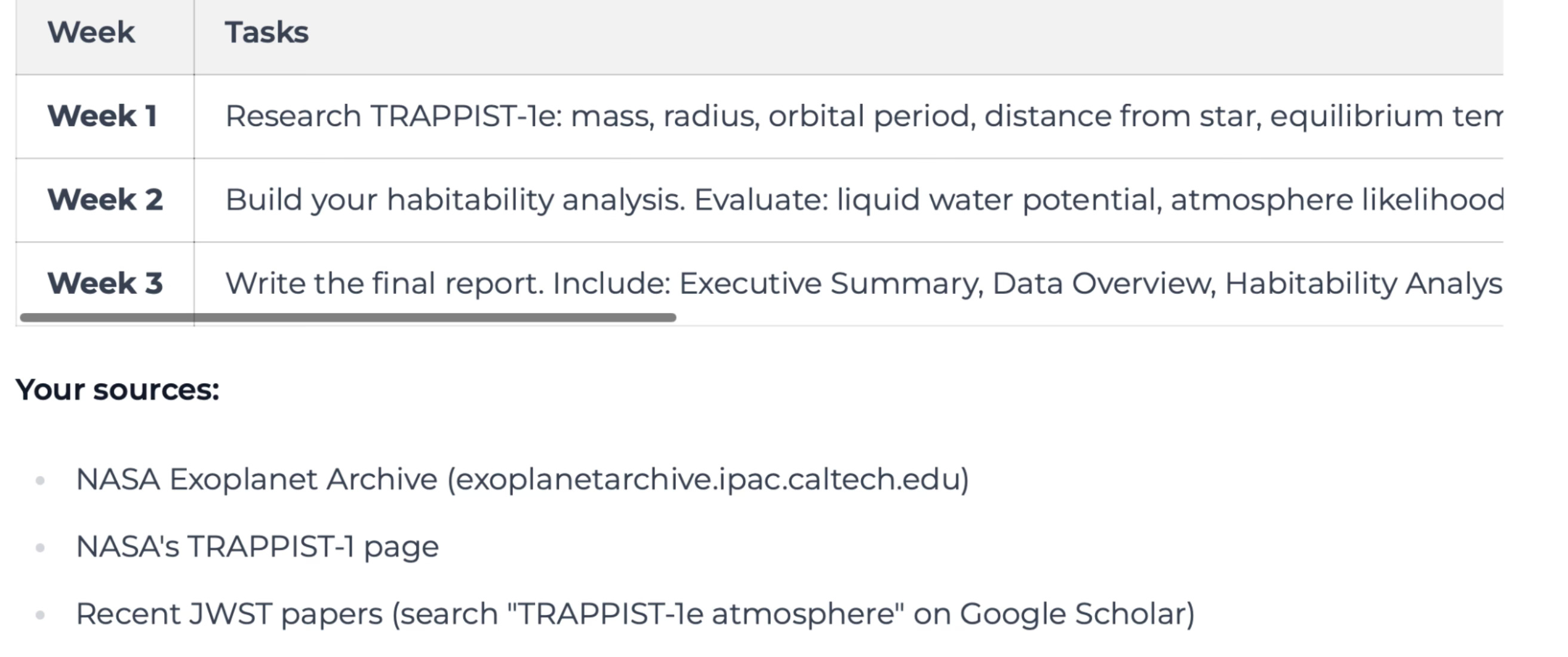
The next slide, though, wasn’t about AI:
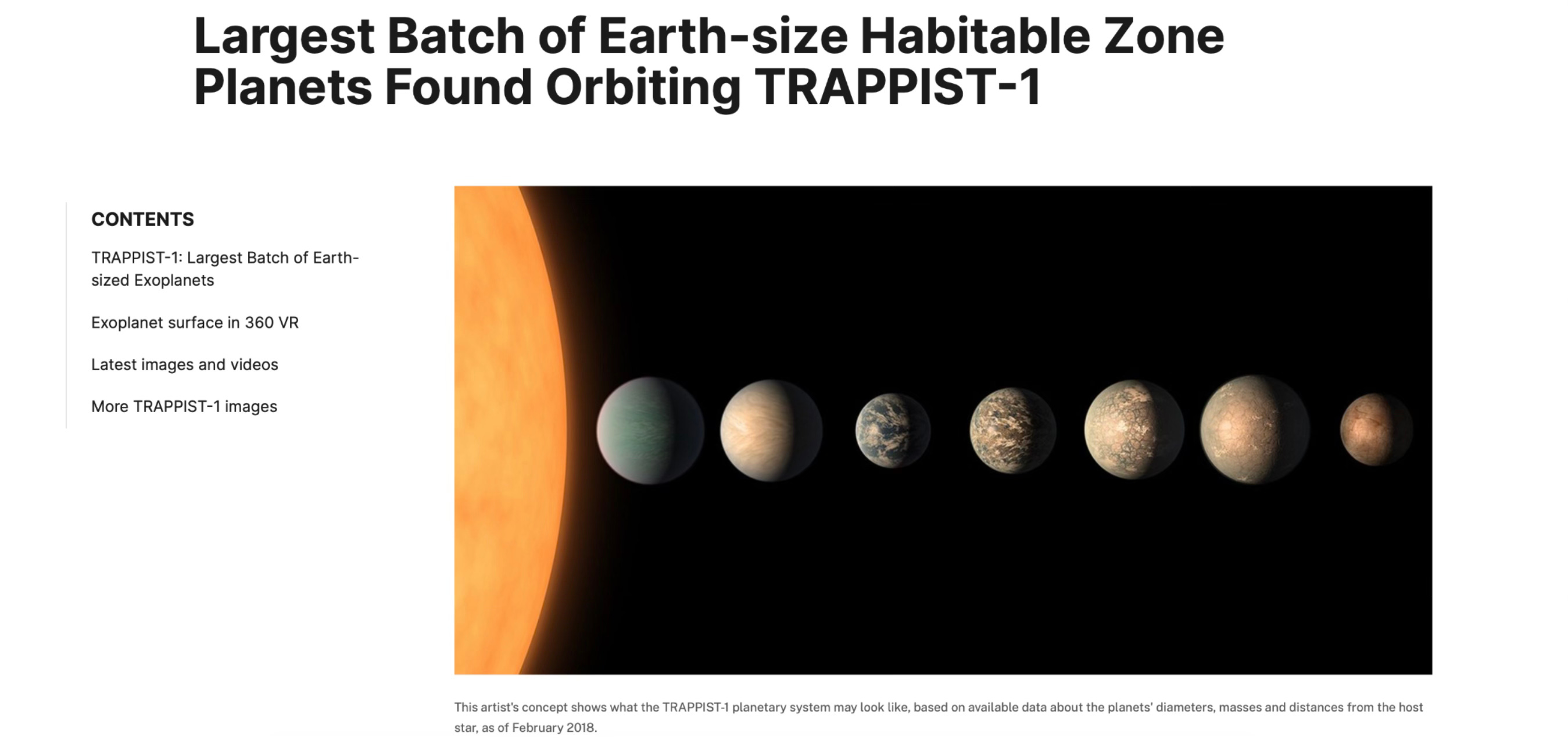
I said to students:
“Remember when the AI suggested a few resources on the previous slide? I went to one of those, NASA’s website about the TRAPPIST-1 solar system. That’s what this is. AI gave me some initial ideas for where to start my research, but then I got off the AI to get into the actual sources for that research. In other words, I left the collective knowledge of AI and went into the specific knowledge of professionals in this field. You should do the same thing as you begin your projects.”
I then showed them a research paper I found referenced on that NASA site:
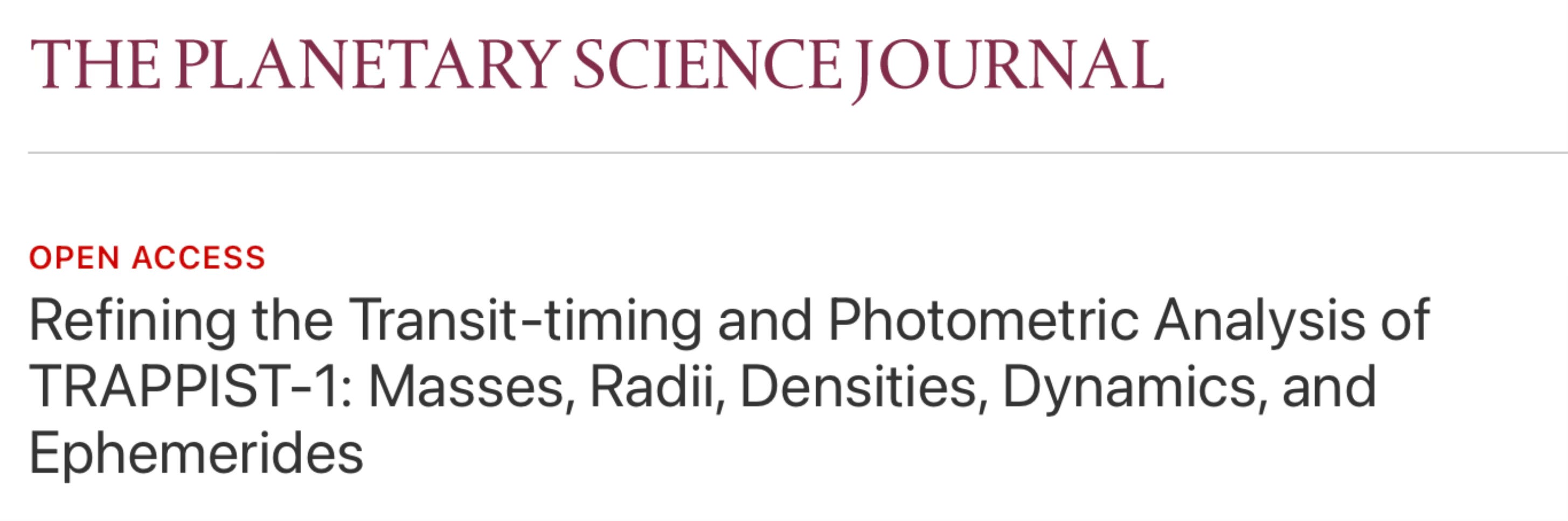
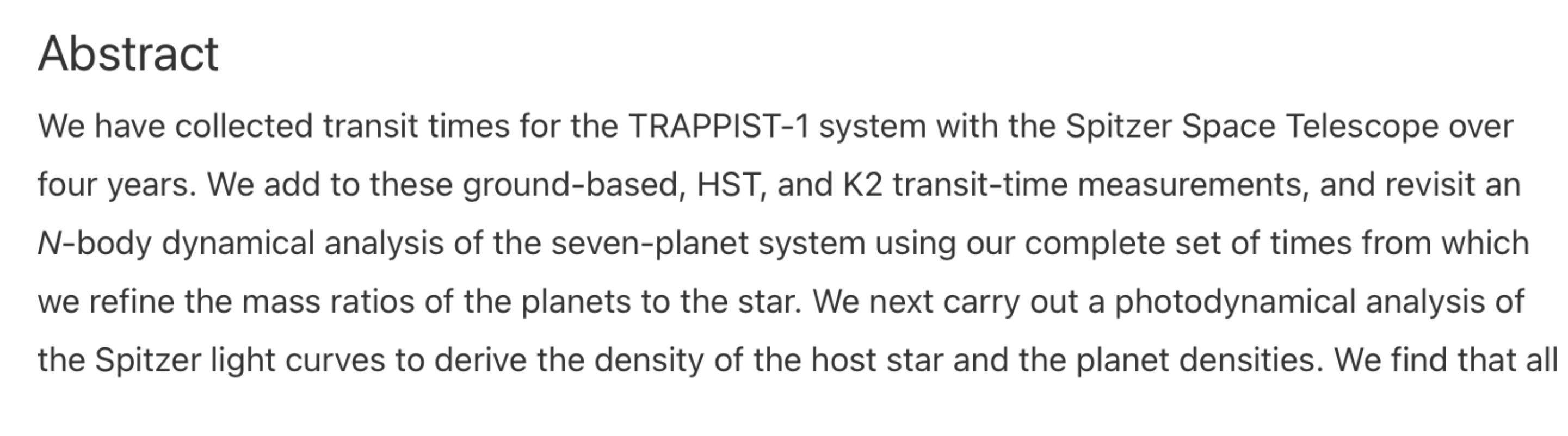
I then said this:
“Remember, for the purposes of this example I’m your age, a senior in high school. So I don't expect myself to understand all the terms or concepts mentioned in this paper so far. (I also can’t say I understand them as an adult either.) That’s OK! That’s what it’s supposed to feel like when you dive into a career you’re exploring. You’re not doing career research right if you understand everything you encounter immediately. The point is to get into the deep end of a professional field to see how that feels.”
But then I added:
“At the same time, it's not useful to stay confused. The goal is to gradually learn how to swim in the deep end of a career field. That’s where AI can come into play. It can act as swimming assistant, like those floaties little kids wear, while you learn how to navigate these new waters. Here’s what I mean.”
I then showed them how I had uploaded that same research paper to our class AI Assistant and asked the key question given my project goals:
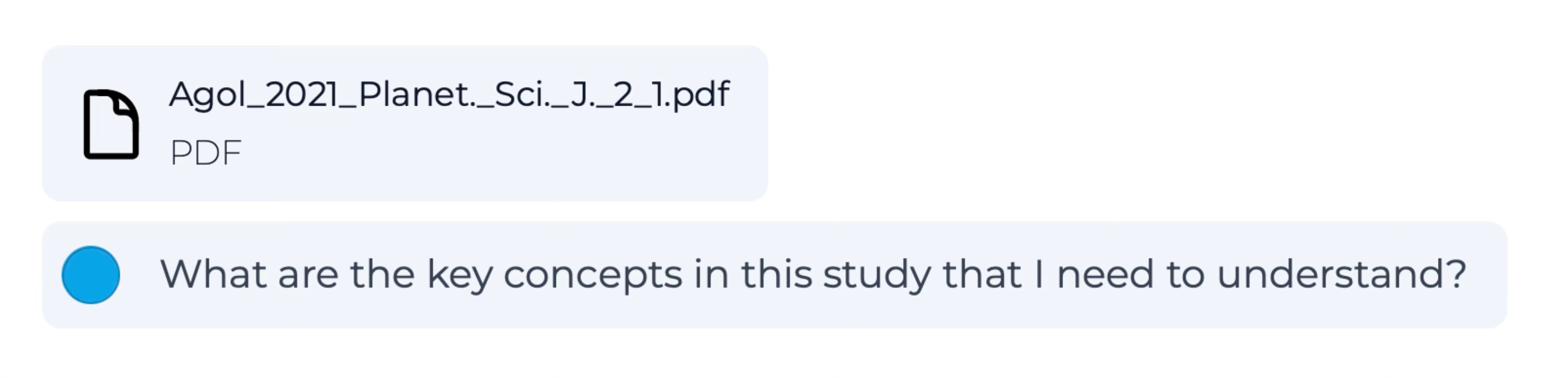
I then showed students how the AI responded:
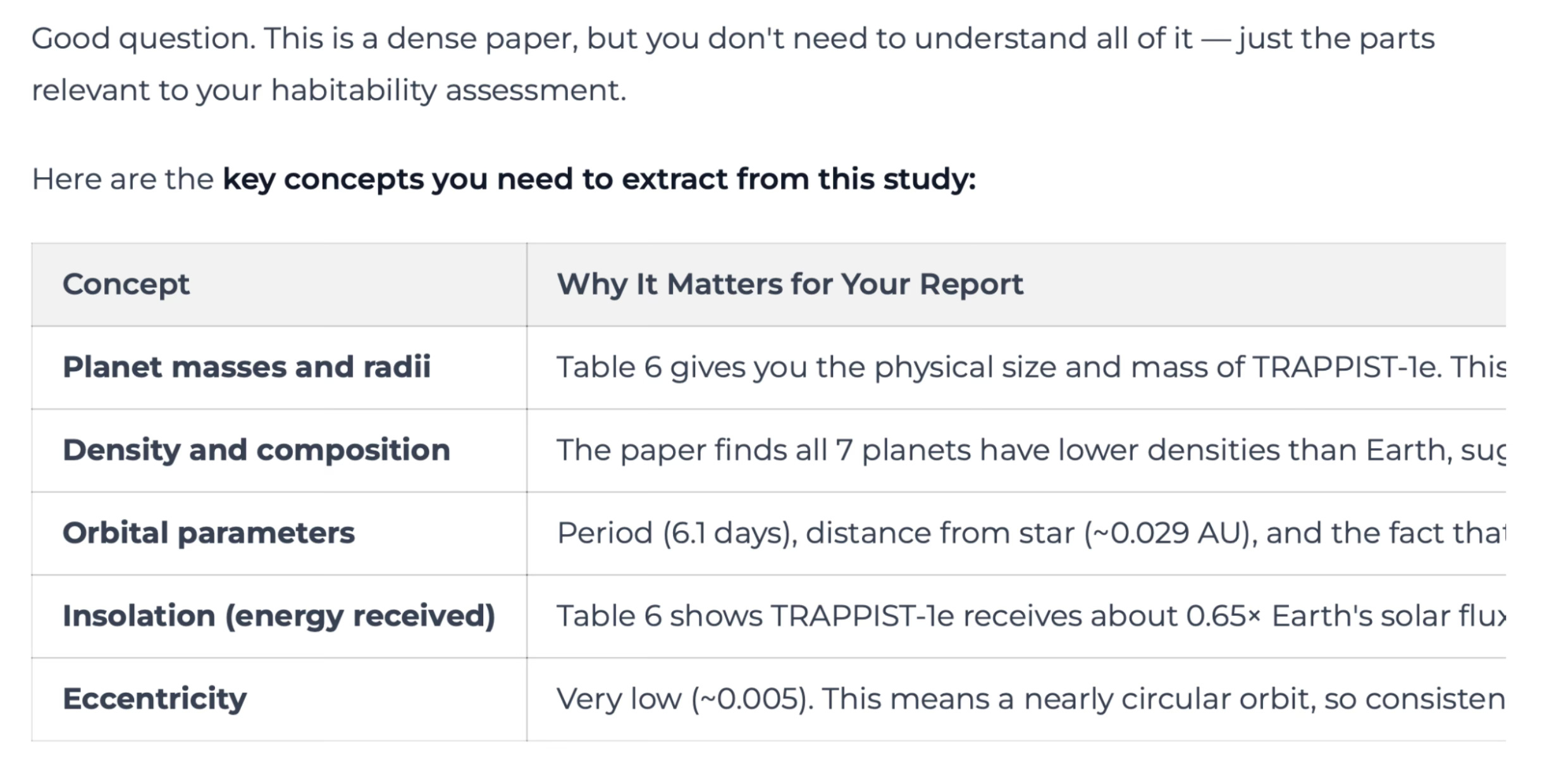
I then said to students:
“Now I leave the AI again and go learn about those topics. I can use a variety of resources to do that — maybe even AI as a tutor — but the point is I’m not spending all my time in that AI conversation. It’s a jumping off point for broader research and learning about the career I want to explore.”
I then added what I think is a crucial point for high school students to hear:
“Remember, for this example I’m in high school, doing initial research into the field of astronomy. So using AI to find the key concepts in an exoplanet research paper without reading the whole paper, which I can then learn about on my own, is a good way to start.
But if I was in college, I shouldn’t be doing that. I should be reading the paper entirely myself, because at that point I’m potentially majoring in astronomy — I’m getting deeper into the field. The way you use AI now, as you first get into the deep end of a field, is not how you should be using it later on. The stronger a swimmer you become, the more using AI floaties could end up holding you back.
You need to keep using your judgment, and the judgment of other people in your field, about what the right amount of AI is.”
I then had students turn and talk to review what effective AI use would look like in their Loop 5 projects and I took a few share outs after. All of the above took less than 10 minutes of class time.
Then we moved into the main part of class, where students got to work and put that two-step AI approach into practice. Here are three examples. (As in all my posts, I’m using pseudonyms for student names.)
Jennifer and Sheila
Jennifer is exploring the role of a certified nursing assistant (CNA) for the first time this loop, and Sheila has been considering a career in speech language pathology for several loops now (including spending a day in January shadowing a speech language pathologist at an elementary school connected to our high school).
The two students had decided to collaborate on their Loop 5 project. With AI’s help, they had created an imaginary patient, Jayden, who needed the kinds of support both CNAs and speech pathologists provide.
On Tuesday, they each opened their Chromebook and uploaded Jayden’s patient description to their respective AI Assistant to start a simulation. (Jayden’s patient description included the context the AI Assistant needed to understand this was a simultaneous simulation that involved input from both students.)
Jennifer, on her laptop, tried to help Jayden start his day in the hospital. However, he was reluctant to communicate. The AI prompted Jennifer to ask Sheila what interventions she would first make as a speech language pathologist. Sheila then explored possibilities online, not on AI, eventually choosing one and trying it out in the AI simulation on her laptop. When that proved effective, Sheila explained the intervention, which Jennifer then put into her AI’s simulation so she could proceed with her CNA experience.
The two-step move here was that neither student could proceed with their AI simulation without collaborating with the other first. Human interaction was built into their process, as was non-AI research into speech pathology practices.
Benjamin
Benjamin has been lost in recent loops, in the best way. He’s very unsure of what direction to take when he heads to college next year. One loop he looked into nursing, the next he became a stock trader. I’ve been telling him how great it is he’s keeping an open mind, that this is the time in life to explore, before the pressure of college tuition and college majors and college internships begins.
But now that we’re in second semester of senior year, he’s understandably getting less patient with himself and with my reassurances. He really wants to make the most of this loop and come out the other side with some clarity.
I told Benjamin I would sit down with him to talk about his Loop 5 vision about halfway through class, once I had a chance to make sure other students’ projects (like Jennifer and Sheila’s above) were underway. In the meantime, I told him to talk with the AI Assistant, which I had built to also help students explore careers if they’re still feeling unsure. When he opened it, he told me later he had an exchange like this one:
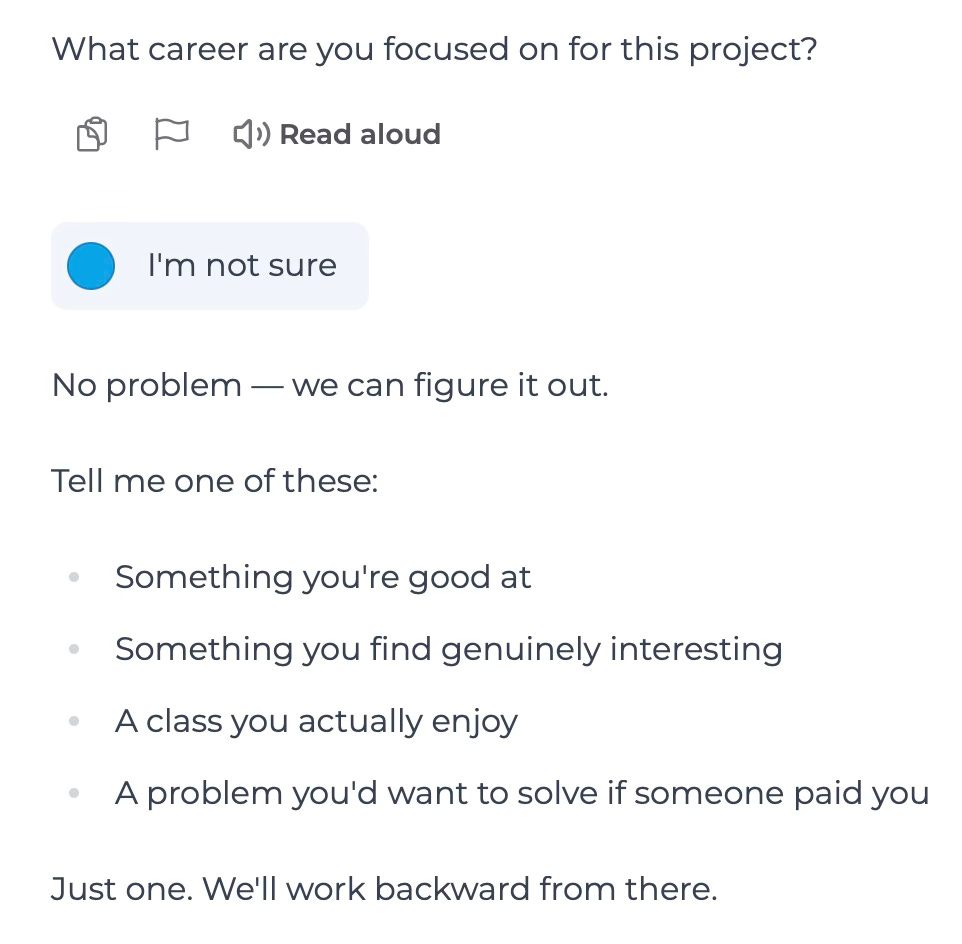
After a few minutes of back and forth with the AI, he had reached the conclusion he told me when I sat down next to his desk: he wanted to focus Loop 5 on marketing.
We talked about why for a minute or two, and then I told him that another student in the class, Tishaya, was spending Loop 5 trying to launch a new streetwear brand. I suggested he talk to her to see if he could run her brand marketing.
When I came back a few minutes later, she had agreed. I then told Benjamin to look up famous streetwear brands with a similar vibe to Tishaya’s and see how they do their social media marketing, and then work with Tishaya to see what she wanted to emulate in her marketing campaign.
There again was the two-step: Benjamin started on AI, then talked to me, then talked to Tishaya, then spent time on the non-AI internet, then went back to Tishaya. His next step will be to return to AI to get help with a professional’s approach to social media marketing, which neither he nor Tishaya nor I have experience with.
Ariel
Ariel walked into class Tuesday brandishing real, high-profile court documents.
She’s using Loop 5 to explore estate law. She did the same in Loop 4, when she used AI to recreate the chaotic, real-life unfolding of Aretha Franklin’s multi-will estate drama. In that case, Ariel inserted herself into that process by having AI give her ongoing decisions she needed to make as an estate lawyer working on that case.
In Loop 5, she wanted to make it more real. So, entirely on her own initiative, she accessed public records associated with Chadwick Boseman’s estate from a California court and printed them out. She had already begun highlighting them by the time she came into class and was very excited to show everyone.
Once class began, I suggested the two-step, asking her if she wanted to upload those documents to the AI Assistant to get help parsing the more arcane estate law details.
Ariel didn’t miss a beat: “Mr. T, you know me. I already did that this morning. That’s why I’m trying to figure out why his residuals were put in a different part of his estate from everything else.”
She already knew the next step (or two) to take.
The AI Two-Step in a nutshell:
Step one: Use AI to get oriented. Let it suggest a direction, break down a project, support your reflections and exploration.
Step two: Leave the AI. Talk to people. Take a field trip. Explore the actual internet. Read primary sources. Build a prototype. Then return to AI when you have new context and questions to bring.
What makes this tricky, and what I’m still wrestling with myself, is that the right ratio of AI to everything else isn’t fixed. It changes as students develop expertise. I wouldn’t want Ariel using AI in that way once she’s on her pre-law track next year. We need to get Benjamin in front of some real marketing professionals at some point. Jennifer and Sheila need to eventually move from our AI Assistant to OpenEvidence.
No two students should be doing this two-step in quite the same way. And the right two-step for them today won’t be the same in two years — or even two months at this rate.
Hey Mike, love this process. I like how you integrate AI use while also having students interact with one another so the collaboration isn’t only with the LLM.
What really hit me while reading your article is that part of the reason so many of us are struggling with this is because it can’t really be standardized. Your students are all working toward similar goals, yet each one has a completely individualized path in how they’re using AI to get there. That feels like the heart of the challenge right now.
I’m really appreciating your step-by-step reporting and the clarity of your process! i’m giving you a Pathfinder award!